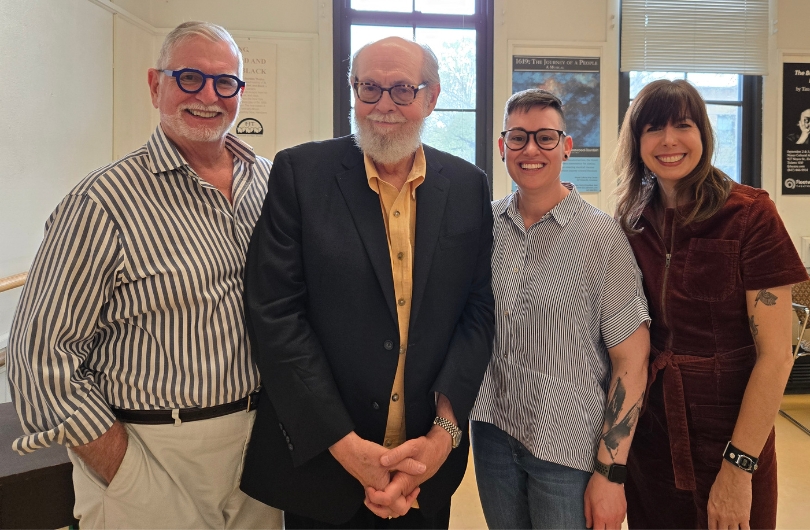
Our Artistic Director BJ Jones sat down with the playwright of Gaslight to get the scoop on why he decided to adapt this classic thriller.
BJ: What was it that inspired you to adapt the Patrick Hamilton play?
Steven: I have an enduring obsession with thrillers for the stage, and have been fortunate to write and premiere several of them – including How a Boy Falls at Northlight in 2020. I’ve long believed that Patrick Hamilton’s Gaslight (originally titled “Angel Street”) is the gold standard of stage thrillers. With the support of the Hamilton estate, I was granted the chance to renovate and update the existing play, while hewing closely to the remarkable twists and turns in the original. It’s been a delight and an education to do so.
BJ: The term gaslight has become fashionable in a pejorative way, and its current meaning is perfectly embodied by the play. Can you talk about that?
Steven: Its meaning is not just embodied by the play; the phrase itself came from the play. Though it has now become ubiquitous, the notion of “gaslighting” started with this 1938 play in which a husband is trying to make his wife think she is going crazy. The eerie, flickering gas-flamed lights in the play are used to signal both Bella’s suspicions and her devastating fears. In 2022, eighty-one years after the play premiered on Broadway, “gaslighting” was named the word of the year by Merriam-Webster.
BJ: Your version has comedy in it which attracted me to your script. That release is structurally valuable to the tightening tension. Talk about that dramaturgically.
Steven: I agree with you about that “release.” Let me come at my answer this way: Gaslight is not a drama; it is a thriller. The difference means that there is a consciously heightened sense of urgency and danger. It is this same heighted quality that frees the story to have moments of comedy, however desperate the situation. Sergeant Rough, as written, is a fundamentally comic character – who just happens to be on a deadly serious mission. Finally, much of this play operates on our empathy for Bella’s dire situation. And there is nothing more empathic than humor.
BJ: Steven as a long time artist in our field, like myself, you’ve seen a lot of change, budgets, audience tastes, the work itself. You taught playwriting for many years yourself giving you a unique observational position of the next generation of artists. Tell me about what you observed. Are you hopeful? How do we attract the next generation of artists and audiences?
Steven: First off: our generation has not finished its work. There are still substantial plays and projects for us to contribute, with the gifts of hard-won experience and expertise on our side. Secondly: the next generation of artists are ready. I’m confident on that front. They have vision and moxie and boatloads of ambition. We just need to keep the theatres open.
Great art is fundamentally reactionary; it is forged – like a rare diamond – from the exertion of great pressure. Our society is under extraordinary pressure right now, but I think of the landmark American plays that were forged by the great Depression, the civil rights movement, the AIDS epidemic, and other threshold moments in our culture. The theatre artists of this moment must be challenged to stand up to these times – and that doesn’t mean just political plays, it means plays of both engagement and delight, plays that revel in the theatre’s one unmatched and transcendent trait: intimate proximity. This is a “gathering” art form, standing alone in an increasingly remote and privately-curated culture. I am confident that the audience’s hunger to gather – to cry, shout, laugh, or mourn together – will endure. I am confident that we have the creators who can bring us together. [Remember: when autocrats come to power they don’t lock up the accountants. They lock up the artists.] We just need to keep the theatres open.