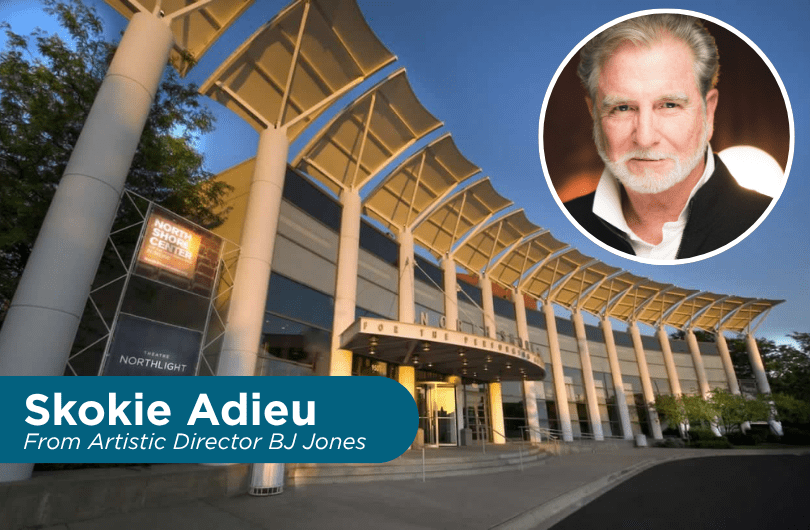
In preparation for the first show of our 2026/27 season, Artistic Director BJ Jones sat down with playwright Jeffrey Hatcher to discuss all things The Front Page, from the art of adaptation to finding that perfect laugh-out-loud moment. Check out the interview below, and grab your tickets to The Front Page to see all their work in action!
BJ: What do you begin with in the adaptation process, aside from reading the original?
Jeffrey: The first rule of adaptation is Do No Harm. If an older play works well, you don’t want to muck it up, and The Front Page works very well, but it’s a huge three-act play with a lot of characters that carries some of the baggage of its time: the 1920s. There are certain social, racial, and ethnic epithets thrown about that these days would pull the audience out of the play. I haven’t excised all of those because The Front Page has grit and edge and its dialogue has the acid and tang of its time. So there should be some things that make the audience think to themselves, “Yeah, that’s what this time was like. That’s how those people talk.” But the goal of the adaptation in this case is to focus on the characters, the story, and the comedy and not to allow any of that to be derailed by contemporary views on antique language and mores. With any adaptation, I try to find the spine of the work, the essential story, the superstructure of the plot and its core, whatever that core might be. The adaptation has to be faithful to that core. The core can be the spirit of the play: comedy, politics, passion. As long as you don’t betray the core, you’re free to change dozens of things that feed into and from the core. You can cut characters, add characters, cut dialogue, change dialogue. I also look for structural and dialogue fat.
The Front Page was written in three acts, and probably ran close to three hours in performance. We don’t really have patience for that these days, especially for a comedy. So one of the things you look for in restructuring is where you can put an act break for one intermission. What’s the best cliffhanger already in the play, or must you create one?
The last thing I look for isn’t something you can find by staring at the script; it’s by spending time in rehearsal with the director and actors. They’ll bring all sorts of ideas and possibilities that suggest new lines, new bits of business. That’s what excites me, and that’s what keeps the show fresh.
BJ: You’re undoubtedly one of the most well-read theatrical historians I know, and I’ve always delighted in sharing backstage stories with you. What animating force continues to delight you in the theatre over the years?
Jeffrey: For me, the animating source is always laughter and surprise. The great theater stories tend to be the funny ones: drunken actors missing their entrances, telephones ringing on stage when they’re not supposed to, audience members talking back, and how the performers on stage deal with these moments.
One of my favorite stories involves a production of Julius Cesar. Brutus and the others have just stabbed Caesar to death. There’s a pause, and a phone in the wings starts ringing, and the assassins are all standing there holding their bloody knives as it rings on and on until one of them says, “What if it’s for Caesar?”
Surprise is the best, though, and that usually comes when you’re watching a play you know very well, a classic, say, you’ve seen it a dozen times, but tonight a moment is created on stage that you’ve never witnessed before. Something between the actors. No lines have been altered. Nothing in the text has been betrayed, but there’s a sudden insight into a character or relationship. You think to yourself, as many times as I’ve seen Death of a Salesman or The Seagull, I’ve never seen that. Hoping for that kind of surprise is what keeps you going to the theater.
BJ: Your mastery of structure and rhythm is one of your gifts; where does this come from?
Jeffrey: I started in the theater as an actor, and if you act in a lot of plays, especially classic plays – let’s call it the standard repertoire – the structure of good playwriting seeps in by osmosis. You know in your muscles and your senses when a scene is supposed to end, or there should be a plot twist. It gets in your bones.
I’ve also learned a lot about structure by doing adaptations. When you’re thinking about how to wrestle a new book or an existing play onto the stage in a new form, you’re always thinking about how it’s built. How to deconstruct it and reconstruct it. Adaptation is heavy surgical work, and a surgeon has to know anatomy backwards and forwards. I think it’s the same with plays.
BJ: Comedy is the hardest of disciplines, but you seem to create great opportunities for humor as well as writing your own very funny stuff. Can you talk about that?
Jeffrey: I don’t know why some people are funny. Some of it has to do with perspective and intelligence, but 95% of it is instinct, and instinct moves faster than thought. Dick Cavett said that when Groucho Marx was on his talk show, Groucho would say something very funny, very fast, and as the audience laughed, Groucho would get a look of surprise on his face as if to say, “Even I didn’t know I was going to say that.”
It’s very important to keep that instinct alive and not check or inhibit yourself, which can be tricky when you work, as we do, in censorious times. A funny line is rapid response, and if you’re worried about how it’s going to be received, you’re going to stifle rapid instincts.
Of course this is mostly about comic dialogue. Comedic structure – situations, farce, etc. – can be learned. The best place to hone comic skills is in front of an audience. That’s why previews are so important. The audience teaches you what your best material is. There’s a Carol Burnett line: “Individually, audience members can be right or wrong, intelligent or stupid. But collectively, as a group, they’re never wrong.”
BJ: You’re one of the most collaborative playwrights I know. You also have a television background; did that inform your generosity of creative spirit?
Jeffrey: I’ve worked in television, but I’ve never been in a “writers room” where people are pitching story ideas and jokes. The theater is where I’ve learned collaboration. If you’re in rehearsal and things are working well and a director tosses an idea and actors are tossing ideas, if the playwright’s ego is healthy enough, he or she will run with some of those ideas. There are a few of my plays that contain a line or two that were suggested or ad libbed by an actor, and they’re pretty funny. I wouldn’t include them if they weren’t. I don’t have a problem with that because the ad lib was engendered by the play I wrote. Playwrights, actors, directors, we’re all part of an organic process called “putting on a show.” So if an actor thinks up something really funny and it fits and it works, I’ve got no problem taking it – with their permission, of course. Naturally, I get to keep the royalties.