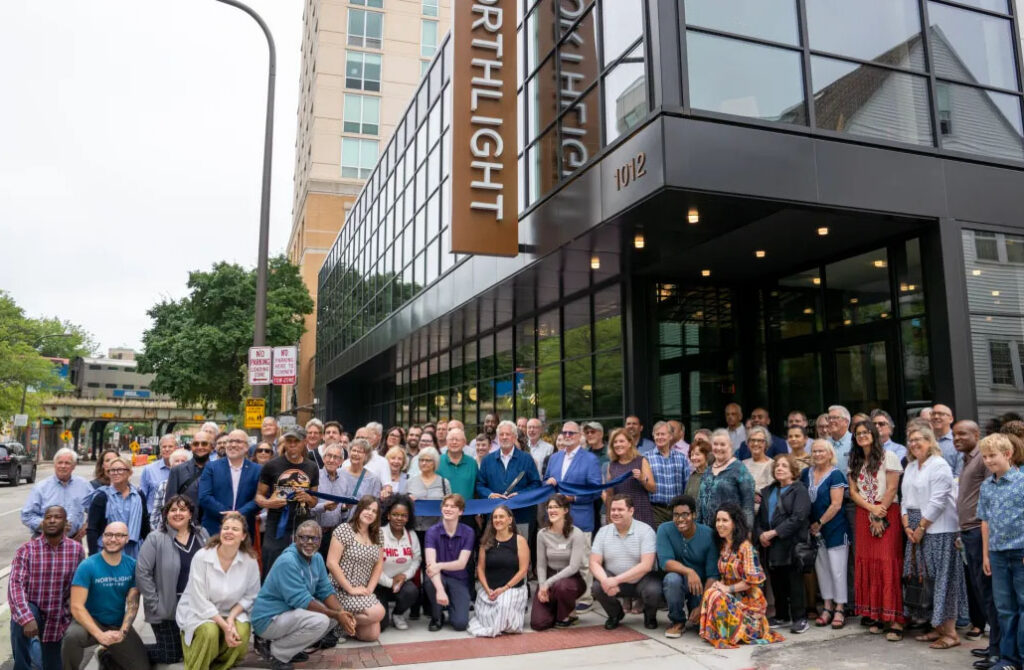
I asked my predecessor, Russell Vandenbrouke, whose tenure lasted from 1987 to 1998, to recall the journey from Kingsley School to the North Shore Center, which was a wild and difficult trip. The North Shore Center was our home for nearly 30 years and helped Northlight stabilize after 2.5 years of producing in different venues. It speaks to the loyalty of both our board and our audience. It is perhaps a bit of “inside baseball.” Still, it’s important to recall the struggle to survive, our audience’s passion for our artistic mission, and the determination of so many artists to make their voices heard.
It is a proud retelling of history. It lifts up so many who have helped us to this moment and who should be celebrated for their efforts. It also reveals the indomitability of the theatre, which, despite claims that theatre is dying, proves it is evergreen, as long as artists have something to say and audiences are passionate about engaging in the conversation. And our art must lead that conversation.
-BJ Jones
On the Road for Seven Years with Northlight’s Previous Artistic Director Russell Vandenbrouke
BJ: Russell, during your tenure, you moved Northlight twice, not to mention being itinerant. Can you talk about those challenges?
Russell: We were peripatetic for two and a half seasons, BJ, thirteen discrete productions across
Chicagoland in eight separate theatres. We—and I include audiences as well as artists and
staff—never enjoyed two consecutive productions at the same theatre. Challenges? Here’s a way to quantify them: In my eleven seasons, we mounted 59 productions at ten different theatres plus co-productions that moved to Berkeley, Seattle, and Pittsburgh.
The story of Northlight’s serial dislocations has never been told. I’ll start with a caveat that theatre colleagues know, but others may not: The collaborative and collective nature of making theatre means many people work together to mount a production. The same goes for creating a home. The proverb that “success has many mothers, but failure is an orphan” applies. Northlight had more than its share of facility woes, but it persisted, survived, and sometimes thrived thanks to artists, audiences, staff, trustees, and donors. Most are unnamed here, but their names appear in decades of past programs.
“Home” #1, Kingsley Elementary School
Michael Maggio, my predecessor, quipped that decommissioned Kingsley made Northlight a “home of high standards and low urinals.” Everyone knew Kingsley was imperfect and impermanent. Michael bequeathed me a “Facility Requirement” plan from Northlight’s 11th season that outlined quantitative needs: so many square feet for a stage, so many for the house, lobby, offices, etc. It included a 400-seat mainstage and a smaller second stage.
After two five-year leases, District 65 switched to one-year terms, prompting a search for alternatives that included two former movie theatres, a closed high school, and a parking facility planned for Church and Chicago. Perhaps others. The board received a feasibility study for a capital campaign it had commissioned two weeks after my first production opened. It estimated the theatre could raise $1.5-3.0 million. By the end of that season, the 13th, a new strategic plan named “control of a permanent facility” a primary goal. After the next season, I wrote in the NEA application, “We do not control our own space nor, therefore, our destiny.” The board had not yet begun a campaign. During the 15th season, District 65 confirmed it would reopen Kingsley in 1991 to accommodate the Baby Boom. Then, the schedule for asbestos abatement changed abruptly, which necessitated leaving a season sooner, just as we were poised to mail thousands of brochures for the season ahead, emblazoned “Free Parking” at Kingsley. Aargh. We covered that false claim with stickers and promised to tell patrons where the heck we were performing once we knew . . . but please, please, please “Subscribe Now!” P.S. Managing Director Susie Medak had announced in April that, after six years, she would depart that summer for a West Coast theatre.
“Home” #2, The Coronet
Oy. Scramble, scramble for offices, rehearsal space, and a place to perform. Before my time, Northlight had considered the Coronet and decided it wasn’t serviceable, but it looked
more and more attractive as alternatives dissolved. Protracted negotiations concluded in August with a three-year lease plus a one-year renewal option. The location was perfect: across from the Main St. “L” for staff, artists, and access to a huge Chicago audience, plus excellent restaurants nearby. Location, alas, was its primary attribute.
It opened as a movie house in 1915, when film was such an uncertain business that the Chicago Avenue frontage included a retail shop. Imagine a minuscule 7-Eleven just large enough to convert into a box office. The projection booth—above the cramped lobby and accessed via a spiral staircase inside the former store—included space for the owner/operator/ projectionist to live if the movie business tanked. The Coronet possessed zero interior appeal, but its vintage marquee, added in the 1930s, was inviting.
For those who never experienced the Coronet: imagine a concrete shoebox, narrow, long, and equally charming. The auditorium was barely raked since it was built for audiences to gaze above obstructing heads at a huge screen. Watching actors meant poor sightlines. We added that stage, a crossover, dressing rooms, stations for wardrobe and props, lighting positions, and more, transforming it to seat 400, semi-serviceably. But on wintery nights, the wind and snow howled eerily through warped emergency exits. The renovations cost $165,000, none of it anticipated or budgeted three months before. For opening, we made T-shirts proclaiming, “We Built a Theatre in 47 Days.” Jim Card, the Production Manager who supervised the construction, departed soon thereafter, exhausted.
But the 16th season opened, as planned, with a play focused on Eleanor Roosevelt. Its run overlapped with Northlight’s From the Mississippi Delta, remounted at the Goodman Studio. Each Coronet season included at least one world premiere: Jeremy Lawrence’s Uncommon Ground had the misfortune to open the night the Gulf War began. Rick Cleveland’s The Rhino’s Policeman was one of seven productions supported by the Kennedy Center’s Fund for New American Plays; Steven Dietz’s Lonely Planet received funding from New American Plays of the W. Alton Jones Foundation, and Martha Boesing’s My Other Heart received support from a second Kennedy Center grant. Northlight was the only theatre in the U.S. to garner national support from these competitive programs for three consecutive years. We scored a fourth from AT&T: On Stage, one of nine in the U.S. and England, for Edward Sanchez’s Unmerciful Good Fortune, co-produced with Victory Gardens.
“Home” #3 (almost)
The Coronet was cold, literally and figuratively, the rent high, and the landlord wanted to sell it. The search for alternatives included Northwestern, where we enjoyed cordial relations. Founder Greg Kandel was a graduate. I taught there occasionally. Margo Brown, Lloyd Morgan, and other trustees maintained strong ties with their alma mater. We repeatedly tried, across many years, to formalize a relationship as its professional theatre in residence. A dynamic relationship between classroom theory and professional practice had benefitted me in grad school at the Yale School of Drama, intertwined with the Yale Rep. Similar models exist at Princeton, Harvard, and state universities from coast to coast, but it never fit Northwestern’s priorities or sense of itself.
As Northlight sought alternatives, it decided against purchasing the Coronet. For years, I’d been taking facility notes based on theatres around the U.S. and abroad. These were more qualitative than the quantitative ones I inherited. They began, “Fundamental Assumption: Primacy in all matters of the stage-to-audience relationship, an inviolate core.” Conversations with National-Louis University (NLU) began at the start of Northlight’s 18th season with René Roy, a Northwestern graduate and the genial head of NLU’s Fine Arts Department. As talks evolved toward becoming a resident theatre, they widened to include Richard Friedman—recently hired as Managing Director, our fourth across these tumultuous times and the longest to serve, by far—Dean Ed Risinger, and Northlight’s board. Richard made a smart observation: Northlight would be like NLU’s football team, a source of positive attention and financial support. It felt nice to be wooed after so many disappointments and dead ends, although NLU’s 600-seat proscenium was too big and its stature rather different from Northwestern’s.
A ten-year contract, signed in January 1994 to begin that June after the final Coronet season, would reunite Northlight under one roof—theatre, offices, rehearsal, and shop space—for the first time since Kingsley. Attorney Paul Lurie, a board member, ensured that the contract included an arbitration clause to redress grievances. Alas, those began before the residency did. NLU’s Sheridan Rd. campus straddled two municipalities. Wilmette neighbors complained about the pernicious effect Northlight would have, and gathered lawyers to argue that a professional theatre violated NLU’s “special use” zoning. Their issues were parking and traffic. Richard and an NLU administrator met with neighbors to propose compromises, all rejected. A Chicago Reader story headlined, “The NIMBY Chronicles: Wilmette Repels Thespian Invasion!” After NLU decided it could not win the zoning dispute, it abrogated the contract, leaving Northlight nowhere to perform. Sound familiar? This time, we had yet to print brochures for the coming season, the 20th.
“Home” #3, #4, #5, #6 . . .
Scramble, scramble—again—as we searched for venues, the Coronet no longer being available. Again, we opened that fall as announced—Susan Booth’s production of Quilters—and dubbed the season a “movable feast” tour of Chicago-area theatres: two at the Organic, then headed by Ina Marlowe, and two at Northwestern, where Bud Beyer, Theatre Department Chair, and Guy Bergquist, an old friend from Washington’s Arena Stage, smoothed our way to use the Barber and Louis theatres.
Surviving another season, and in gratitude for past ones, we honored Northlight’s 20th anniversary by festooning the Organic lobby with placards listing the name of every artist, usher, staff member, trustee, or volunteer who ever worked at Northlight. We printed their names in the program too. I did not found Northlight, but holding it in trust for those who did, and for all the predecessors, ancestors so to speak, was both an honor and a gargantuan responsibility, among the heaviest I’ve carried.
Still needing a fifth venue, we met with Fred Solari about the Athenaeum and looked at parochial schools, like St. Scholastica, and the shuttered auditorium of New Trier West. Nothing meshed until trustee Margo Brown and I met with Neal Ney, Director of the Evanston Public Library, then preparing to open its new home on Orrington. Margo made a brilliant analogy: As Odysseus faced challenges and setbacks after the Trojan War, struggling relentlessly to make his way home, so Northlight was striving to make its way back to Evanston. That was fitting for a company whose founder first named Evanston Theatre Company.
The library adapted some of its plans to welcome us, but a Community Meeting Room does not a theatre make, so we postponed the Woody Guthrie musical and needed a replacement. Working with Mike Nussbaum as director, we decided on a “concert reading” of Shaw’s Don Juan in Hell. Care to add more, BJ, since you played the title role? I’ll bet it isn’t your happiest Northlight memory.
When NLU could not settle with the board, arbitration gears began to grind as the first of two-and-a-half nomadic seasons commenced. Wally Greenough, Paul Lurie’s partner, handled our side, the closest I’ve come to being hauled into court. (So far.) Richard and I had to provide our notes, memos, and correspondence. Northlight did not routinely keep formal minutes, so my collection of scribbles to myself, occasional memos, letters, and printouts became our most thorough record. Preparing for the hearing, Wally created a roster of questions, shared them with his witnesses, Richard and me, and set a date to meet at his office to… practice. (I almost wrote, “rehearse.”)
The hearing coincided with the opening of Ibsen’s Hedda Gabler, a tragedy. I hoped that wasn’t an omen. Beginning his interrogation, NLU’s lawyer called me “the inveterate note-taker, Mr. Vandenbroucke.” That’s a fair attribution, though too wordy to memorialize as a new nickname.
Wally’s preparation and commitment to Northlight, his client, paid off. As Don Juan rehearsals began—April of 1995 at the end of our first movable feast—Northlight was awarded $337,000 for breach of contract, specifically the loss of rehearsal space, offices, box office, and other residency benefits.
Alas, this did not “wipe out” the deficit. I inherited $225,000 of debt, remodeling the Coronet added $165,000, and the theatre incurred some annual deficits from unmet fundraising goals, ticket sales, or both. But that settlement, net of expenses, plus an unrelated grant from the McCormack Tribune Foundation brought the deficit to Northlight’s lowest level since 1980, its 6th season.
Before leaving Kingsley, throughout four Coronet seasons, and as the migrant seasons continued, Northlight persistently sought a home—sometimes casually, sometimes through weeks of concerted effort focused on a specific site. If I were to drive around Evanston today, I would spot places we visited, sometimes with a realtor, sometimes spontaneously, like a time I paced the perimeter of a shuttered building on Ridge near Emerson to determine its size.
Two superb locations were across the street from our post-Kingsley offices: the Chase Bank drive-thru on Davis, which the bank did not want to sell, and the empty lot east of it, which might have sufficed with one lane from the adjacent drive-thru, if only . . .
Other possibilities included:
The Pine Yard restaurant, also on Davis. It later burned down.
A “transportation hub” where the El and Northwestern/Metra tracks converge.
The Varsity Theatre at 1710 Sherman. That’s not a typo. A movie theatre was entombed
there when its ground floor was converted to retail stores. Climb twenty feet up a ladder off the alley at the rear and—voila!—behold a balcony and proscenium arch as if a genie escaped its bottle to make magic. Unlike the Coronet, it oozed charm. Conceptual drawings turned Bookman’s Alley into an arcade with an escalator to access a second-floor theatre. Alas, those
gossamer dreams floated into the ether—or maybe the genie is saving them for another day.
Another idea was building out the third floor of a planned convention space in the
Northwestern/Evanston Research Park along Maple. The convention hall was never built and, I gather, little of the imagined Research Park was realized either.
My favorite site was an abandoned powerhouse on Maple near Emerson. Its masonry was worn, its industrial purpose unmistakable, but it contained the fundamental requirements for a vibrant theatre: height and free span, no pillars to block sightlines. Despite minimal curb appeal, I was convinced we could make its rough-hewn essence alluring: “Ladies and gentlemen, boys and girls, come inside for Northlight wonders and surprises!”
Milwaukee Rep had converted a far larger power station into a welcoming complex, so I consulted its architect, Sherrill Myers, and drove Northlight founder Evelyn Salk to Milwaukee for a matinee. She liked the theatre. (But not my driving!) I remain convinced Northlight could have preserved that ugly duckling and transformed it into a graceful swan. With a perfect location, too. Northwestern owned the property and wasn’t interested in preserving or converting the building.
These, and other efforts, encompassed the board’s Facility Committee, but our losing streak continued into extra innings. We met with Mayor Lorraine Morton, City Manager Eric Anderson, Charles Shaw & Company, developers of the Research Park, and Northwestern’s Bill Ihlenfeld, but the smiles, handshakes, and cordial tone of these and other meetings left me feeling like a child with my hand out. Afterwards, the grown-ups, most of them men, patted me on the head and shooed me off to play in the backyard while they returned to important stuff like money, which Northlight lacked.
Leaving Kingsley, then the Coronet, then losing NLU was . . . daunting. The Sunday before opening in Skokie, Richard Christiansen wrote in the Tribune that the board had considered closing Northlight. I don’t recall that. I do remember a trustee saying, “It’s hard to kill a not-for-profit,” which I don’t recall as suicide prevention so much as an expression of hope, dim and left-handed, about surviving. Richard also reported that I once said Northlight was an old dog that should be taken behind the house and put out of its misery. Guilty. Our plight often seemed hopeless. Yet I also recall the instant, in our darkest days, when I caught myself vaulting up the stairs, two at a time, eager to solve problems in my second-floor office. My light steps contradicted my heavy mind. To stay sane across a summer without productions, I needed something creative to ballast what felt like perpetual existential struggle. So, I turned to something comparatively simple and enjoyable: writing a play about the physicists who created the atomic bomb.
The North Shore Center
When construction began in October 1994, NSC’s plan was an 850-seat proscenium plus a multi-purpose room/banquet hall. I gather National Jewish Theatre might have sometimes performed there between touring shows, but in March of 1995, its board closed the company. Killing a not-for-profit wasn’t so hard after all.
The wooing began in September 1995, eleven months after the groundbreaking. I recall watching steel pilings driven into NSC’s perimeter to shore up its sandy foundation: who knew Lake Michigan once extended to Skokie Blvd? I don’t recall who the initial matchmaker was, but the courtship ebbed and flowed. Northlight’s board was relieved our vagabond seasons might end, but that was countered by affection for a cultured, university city on Lake Michigan. Could we leave Evanston for a suburban village, adjacent to a shopping mall? Trade the tether of the “L” and Chicago for car access for the Edens? I shared this class-tinged ambivalence, but we continued talking, problem-solving, and negotiating. Some thought we could use the 850-seat theatre by scheduling around others, but there weren’t enough open dates, and the stage lacked the intimacy I deemed essential for a resident theatre. What to do?
On the next-to-last working day of 1995, I wrote a detailed memo to Steve Mullins, Northlight’s president, explaining my concerns and uncertainties, buttressed by attending a recent Cultural Facilities Fund workshop that reminded those attending that any facility is a means to achieve a mission, not an end in itself.
At a combined Facility/Executive Committee meeting the next week, a board member asked what had happened to our “build from scratch” plan. Mark Vanderpool, Skokie’s Assistant City Manager, had deemed it unfeasible for a variety of reasons, including the footprint being too small, so we returned to discussing the banquet hall/multi-purpose room conversion, which we’d previously deemed untenable. NSC’s business model included income from renting the all- purpose room and banquets catered by the adjacent hotel. He observed, with exquisite understatement, “It’s a rather complicated project.” The sightlines would be poor, the ambience uninviting. Worst of all, it reminded me of performing for children in “cafetoria”: lunchrooms that doubled for all-school gatherings, tripled for performances on a stage, and quadrupled when basketball hoops were lowered from the ceiling. Spaces designed to serve multiple functions seldom served any well. I feared we would be performing in Hilton Hall, not Northlight Theatre. After an architect on the board proposed reversing the concept—a theatre that converted into a banquet hall instead of the reverse—we saw a viable path. Near the end of January, I wrote a close relative, “I spent six hours today with a theatre architect trying to work out a scheme for a new home. It’s very complex, but I’m the most optimistic I’ve been in years. Assuming it happens, Northlight can survive, a none-too-certain fate over the past five years.”
On Valentine’s Day, 1996, the board voted to raise $1.7 million to adapt the shell into a theatre, a decision Vice-Chair Karl Berolzheimer praised effusively. Thirty hours later, Skokie demanded a $1.2 million letter of credit rather than simply the board’s promise to begin a capital campaign. The board announced the capital campaign, chaired by Paul Finnegan and Paul Lurie, at that year’s gala on March 16.
As these pieces evolved, John Morris, the architect, and I focused on design challenges. The height and free-span were workable, but the space was constricted and formed a trapezoid—four sides but only two of them parallel—awkward geometry to manipulate. We needed at least 300 seats, and I wanted them oriented to create intimacy. I had, still have, strong feelings about the responsibility of resident theatres like Northlight to connect with their communities, and the architecture of any gathering space indelibly impacts that. I wanted audiences to see and feel themselves part of a collective experience.
John sketched alternatives, which clarified that the best stage position was on the narrowest wall of the trapezoid, with the auditorium shaped like a bowl, sweeping down to it without any barriers or proscenium. Actors and audiences shared the same space. As individuals transferred from the lobby to their seats, most would move closer to the stage with each step, nearer to the actors and the action. I hoped for a deep thrust, but working with implacable geometry, we ended with a 170° audience arc and no seat more than thirty feet away. I had no prior experience working with an architect and cannot imagine a more knowledgeable or engaging collaborator than John Morris. His expertise, ideas, and solutions never received the recognition or appreciation he deserved.
After these fundamental decisions, a brain trust of designers offered ideas from their years of experience at many different theatres: Claude Binder, Geoff Bushor, John Culbert, Mary Griswold, and Rita Pietraszek. My summary of ideas solicited from staff ran to several pages.
NSC opened in Nov. 1996. Northlight followed four months later with Atomic Bombers, my play focused on physicists Richard Feynman and J. Robert Oppenheimer. I’d met Feynman a decade before while creating a cabaret piece in Los Alamos. Since returning to Chicago to serve Northlight, I’d imagined expanding it to include the first sustained chain reaction, in Hyde Park beneath the University of Chicago football stands. My play had been broadcast on public radio in 1995, following Northlight’s first nomadic season, to commemorate the 50th anniversary of Hiroshima. When Steve Mullins asked at a board meeting why I hadn’t mentioned it for a future season, I said it required too many actors for Northlight, but he persisted—and did not have to twist my arm too terribly hard.
BJ: We’ve kept the shape of the theatre you helped craft at the NSC, which I felt honored the Chicago storefront tradition of being close to the audience so that they felt they were part of the story. It also mirrors the Guthrie, Milwaukee Rep, and other great regional theatres. I remember you once mentioned the Taper inspiring the design. How did you come to that decision?
Russell: You’ve cited an important thread of North American theatre history. When Guthrie was hired to run Ontario’s Stratford Festival, its first season was staged inside a giant tent while its permanent theatre, echoing Shakespeare’s Globe, was rising nearby. Guthrie wanted a similar design for the Minnesota Theatre Company, later named for him, when he became its founding artistic director. Those stages, like the Greek theatre of Dionysus, arrayed audiences around the stage in an arc of more than 180°, which was common for centuries. It’s the proscenium stage associated with Broadway that changed the norm. When I described the Skokie stage to audiences in our newsletter, I used a favorite example to show how natural a thrust stage is: “Imagine walking through Grant Park and discovering a fantastic street performer playing her violin. If she has attracted, say, a hundred people ahead of you, these are your choices: to watch her from a greater distance in the presumed center, or closer to her on the presumed side. Northlight’s new theatre mimics this: ten rows on the centerline, six at the end of each arc. Guthrie’s stages influenced the design of regional theatres, newly rising around the country: the Taper in Los Angeles, the Repertory Theatre of St. Louis, Berkeley Rep, and many others. I was born on the South Side, went to college downstate at Illinois, and am proud to retain my Chicago accent and 312 phone number, but I’m a regional theatre baby, not a product of Chicago storefronts. When Greg founded Northlight, his national perspective was clear from joining LORT, the League of Resident Theatres, a consortium now numbering about eighty of the country’s largest not-for-profit theatres that is committed to union contracts for actors, stage managers, directors, and designers.
BJ: The Coronet and Kingsley are often mentioned by subscribers as fond memories, but they were anything but if you were mounting a play. Any amusing anecdotes about them?
Russell: I suspect fond memories are for plays, productions, and performances rather than place. I have anecdotes of every season and production, amusing in retrospect if not at the time. Here are two.
Kingsley
Thirty minutes into the opening night of George F. Walker’s Nothing Sacred in my second season, the entire stage brightened slowly, then dimmed to black. Then the lights rose again, slowly and in synch, before dimming as before. Stage manager Rick Berg called, “hold,” actors exited, and Rick brought up the houselights as the auditorium’s emergency lights popped on. As the audience milled about, Susie Medak learned from ComEd that the problem was nearby rather than throughout Evanston, good for the audience. But it could not be fixed quickly, bad for the production. What to do?
After consulting with Susie, I took the stage, quipped that I didn’t recall this happening to Micky and Judy behind the barn, and gave everyone a choice: watch the rest of Nothing Sacred—how ironic a title for this anecdote—under work lights or return as our guests for another performance. Most stayed. As usual, when the unexpected happens, the audience enthusiastically supported the company and production. I was relieved but disappointed that Bob Christen’s lighting design would not be appreciated as it deserved. That was rectified, in a fashion, when Hedy Weiss of the Sun-Times returned for her review, reported on the previous malfunction, and offered a left-handed compliment, “the show’s design is its strongest suit . . . beautifully lit by Robert Christen.”
Coronet
As the person contacted whenever emergency and fire alarms triggered, I received those calls outside theatre hours, after the system was set, usually in the middle of the night. I’d crawl out of bed, meet the police, unlock the Coronet, and join them looking for smoke or intruders. We never found either. Still, the alarms continued unpredictably except, of course, in the middle of the night. After several false alarms, my wife stopped worrying, and the police stopped meeting me, but I continued expecting to hear my mother’s voice, newly widowed and in poor health. It never was, but that did not staunch my instantaneous dread.
The last alarm taught me something seemingly useless—except that knowledge never is. Letting myself into the darkened Coronet with my trusty flashlight, I checked doors, looked and sniffed for smoke, and prepared to leave, grumpy as usual, when I spotted a deflated balloon on the lobby floor. It had floated to the ceiling after a birthday party, beyond reach of the celebrants or the tech staff. So what! What harm could it do? When the helium leaked, in the middle of the night, it floated down to trigger the motion detector. That might have been the last time I answered such calls, having learned, in Pavlovian fashion though slower than a puppy, that alarms do not necessarily communicate an emergency.