


It’s 1967 and the world is changing around Chelle and Lank, who run an after-hours club in the basement of their late parents’ house. Tensions mount when the siblings discover that their dreams have diverged, their tight-knit community is threatened by the arrival of an outsider, and the city around them erupts in violence. The music of Motown fuels this riveting new play set in America’s Motor City.
Videos
Photos
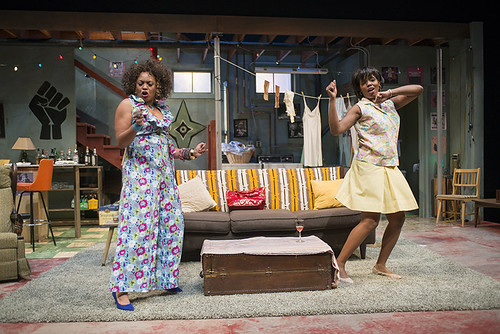


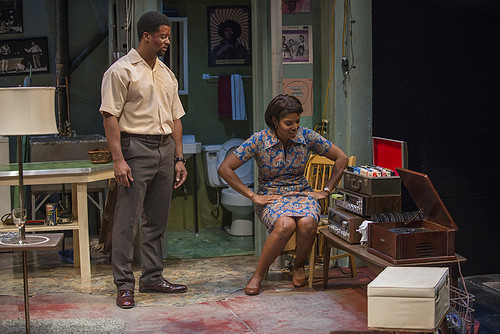


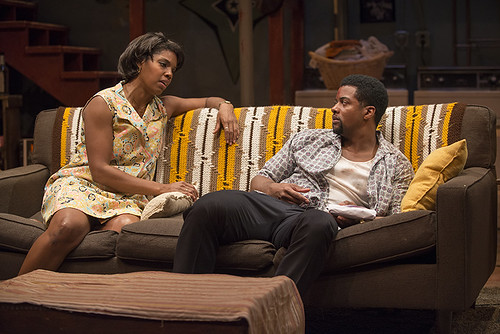
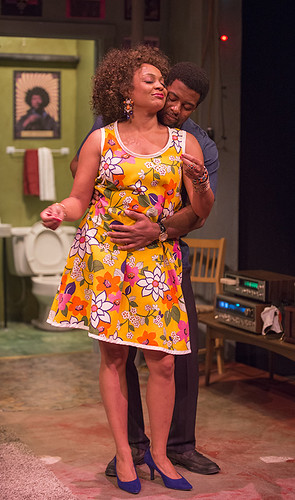


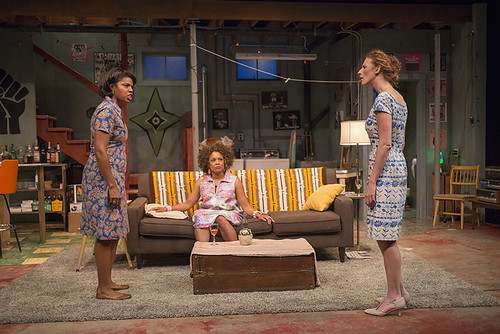
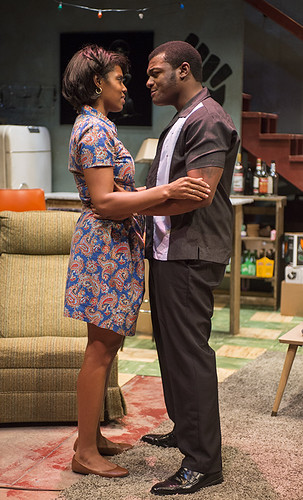


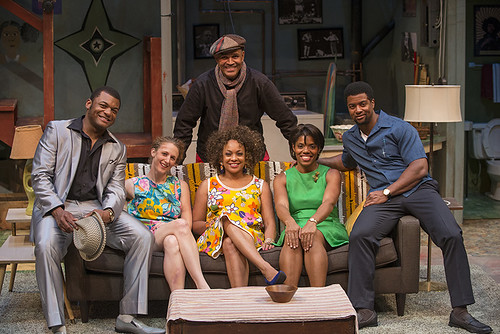
Production photos by Michael Brosilow.
REVIEWS
Motown plays as streets burn, conflicts simmer
CHICAGO TRIBUNE
November 17, 2013
By CHRIS JONES
Detroit ’67 not only is a very interesting idea, but you can see that [author Dominique] Morisseau already has figured out the structure for something much larger and has realized how well huge moments can be represented by small personal experiences. (Her tavern here is not unlike New York’s Stonewall.) Morisseau’s main point, her very telling point, is that the notion of Detroit as “a Negro mecca” was undermined from the start by white menace and corruption. It is represented here not only by telling the story of those vice-infused police officers, which is well-documented in history, but also by the inclusion of the Caroline character, who functions partly as a dangerous sexual siren ready to sap the power of black men, partly as a spy and partly as a reminder of the promise of racial harmony. That last theme is bolstered by the crossover Motown soundtrack, playing on an 8-track player in the corner, singing of love and unity in what history has shown us was a fatal moment in the life of a city.
Having said all that, the Northlight audience certainly responded warmly to this hugely promising play, generally well-acted on Jack Magaw’s straightforward setting … I for one am fascinated by Detroit, where I’ve spent a bit of time. It is fertile ground for writers and artists now in all kinds of ways. And you already can see here that Morriseau not only is invested in this town, but she knows where to look to understand how, where and when things went so badly wrong.
REVIEWS
A city starts to unravel in intriguing Detroit ’67
CHICAGO SUN-TIMES
November 17, 2013
By HEDY WEISS
In her play Detroit ’67, now in a winningly realized Northlight Theatre production, Dominique Morisseau looks at what many cite as the beginning of the Motor City’s downward slide.
She has set her story in the semi-finished basement of a working-class home at the epicenter of the chaos — Detroit’s near West Side — where a police raid of a popular, unlicensed, after-hours bar became the flashpoint of the riots. The owners of the house, Chelle (Tyla Abercrumbie, an actress of great radiance and emotional fervency) and her brother, Lank (the easefully intense Kamal Angelo Bolden), are running a little house-party operation of their own at the time.
In a very real sense, Morisseau has picked up where Lorraine Hansberry left off in A Raisin in the Sun, the 1959 drama that Detroit ’67 director Ron OJ Parson staged earlier this season at TimeLine Theatre. Key to both plays is the opposing attitudes of two siblings. Chelle, a young widow and mother of a son attending Tuskegee University, is determined to hold on to the hard-won gains made by her parents. But Lank, ambitious and restless, wants to forge his own future, taking a risk by buying a night spot of his own with his pal, Sly (Kelvin Roston Jr., all mischief and hustle).
REVIEWS
Theater: ’67 Crystallizes Motown And Madness A Generation Experienced
Northlight Theatre mounted a riveting production of one family’s 1967 experience, from dancing parties to ambition to the great race riot that crippled a city.
GLENVIEW PATCH
November 23, 2013
By JENNIFER FISHER
It’s challenging to tell a personal story that opens the lens wide on a drastic event in history.
Northlight Theatre’s Midwest premiere production of Detroit 67 does it powerfully, examining the experience of an adult African-American sister (Chelle) and brother (Lank) who run dance parties in the basement of the home their parents left them–a convincing 1960s set by Jack Magaw, complete with laundry and linoleum tiles–to earn a few extra bucks.
The dance-party element fortunately gave playwright Dominique Morisseau a reason to lace the play with great Motown hits–from the fun tunes that carry the upbeat mood of the two young siblings and their best pals Bunny and Sylvester, to the pensiveness as the brother, Lank, starts falling into a then-forbidden affection for a white woman, and then the mixture of sadness, grief and resolve that mark the aftermath of how the enormous July 1967 Detroit riot affects the characters.
… [T]his is a well-written, beautifully performed work of theater that puts a human face on the racial strife and riots of the 1960s, showing us, the audience, the toll they took on a vibrant family. Under Ron OJ Parsons’ direction, the essential goodness and compassion of the characters comes through, which makes the events that unfold all the more shocking.
PREVIEWS
Detroit ’67 timely look at the racial divide
CHICAGO SUN-TIMES
November 6, 2013
By CATEY SULLIVAN
ou can’t actually see either of the two galvanizing forces that indelibly alter the lives of the tight-knit brother/sister team at the heart of “Detroit ’67,” at Skokie’s Northlight Theatre. But the infectious sounds of Motown and the terrifying sounds of riots all but serve as additional characters in playwright Dominique Morisseau’s emotionally charged exploration of ferocious civil unrest and equally intense family ties.
In the hands of veteran, much-lauded Chicago director Ron OJ Parson, Detroit ’67 is both deeply rooted in the titular time and place, and as urgently relevant as the latest headlines.
“A lot of people want to say we’re living in a post-racial society because we’ve got a black president, but in some places of the country? It’s worse than ever,” says Parson.
For Langston, Chelle and Sylvester, the danger outside literally enters their apartment when the two men find a young white woman, dazed, bleeding and incoherent, wandering the streets. Simply by doing the decent human thing— taking her in and tending to her wounds — they put themselves in grave danger.
Still, the enigmatic Caroline is a catalyst for hope, says Bolden, so that Detroit ’67 is ultimately a joyful, hopeful play.
“There’s positivity that eventually shines through,” says Parson, “We’re still fighting a protracted struggle. But we’re making progress.”
Top 5 non-holiday Chicago shows
No taste for chestnuts? Here are 5 holiday-free alternatives
CHICAGO TRIBUNE
November 27, 2013
By CHRIS JONES
[I]f you are interested in the history and fate of the Motor City, Detroit ’67, which is the work of a very promising young writer named Dominique Morrisseau, offers some provocative insights into how the past has informed a bankrupt present. I was struck by how engrossed the Northlight audience seemed during this piece.